
Reading time: 4 minutes
TL;DR
Most leaders lose clarity between Monday and Wednesday. The solution isn’t another strategy deck—it’s a 5-minute weekly visual check-in. Draw three circles (Vision • Focus • Action), reconnect with what matters, and adjust. One sketch beats ten status meetings. This article shows you how
In a world where leaders are drowning in meetings, reports, and notifications, the biggest advantage isn’t speed.
It’s perspective.
That’s why the most effective leaders I work with don’t start the week with goals. They start with a map.
Not a complex strategic framework. Not a 40-slide deck. Just a simple visual that answers one question: Are we still heading where we said we’d go?
Because here’s the truth: clarity fades fast.
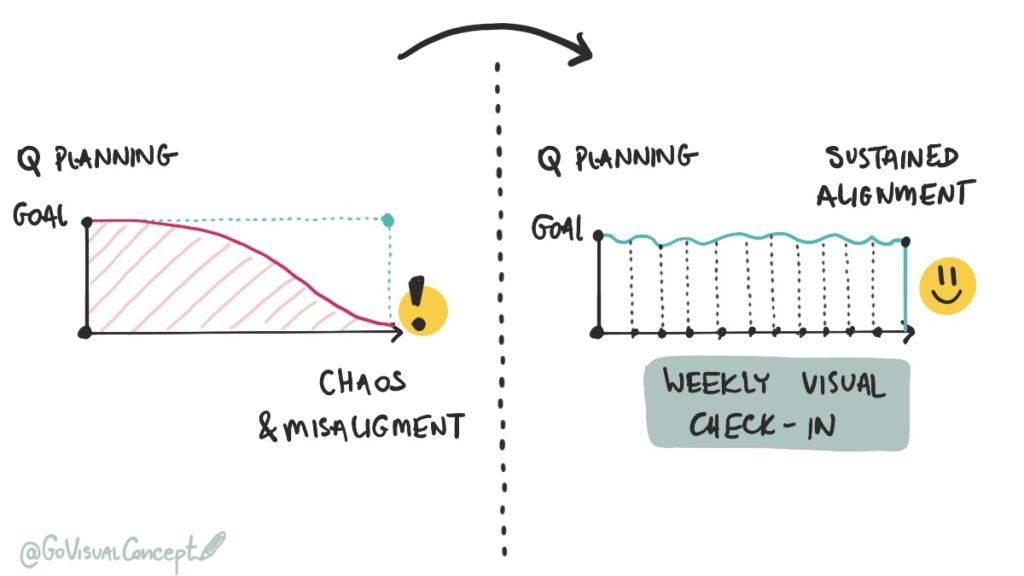
You leave a planning session aligned. Everyone nods. The vision is clear. Then Monday hits. Emails pile up. Fires need fighting. By Wednesday, half your team is chasing different targets. This isn’t just a feeling; it’s a data point. A Gallup poll found that only 22% of employees strongly agree their leaders have a clear direction for the organization.
You’re wondering why execution feels so scattered.
The problem isn’t commitment. It’s connection loss.
Why “Big Picture” Is a Muscle—Not a Moment
We treat strategic clarity like an event. Annual planning. Quarterly reviews. The big offsite where everything gets “realigned.”
But clarity isn’t built once a year. It’s maintained every week.
Think of it like navigation. You don’t plot a course once and assume you’ll stay on track. You check your position. You adjust for wind, current, changing conditions.
Leadership works the same way.
The solution isn’t another meeting. It’s a 5-minute weekly ritual—a visual check-in that reconnects you (and your team) with what truly matters.
Not because you’ve lost direction. But because staying aligned requires rhythm, not just intention.
The 5-Minute Alignment Habit
Here’s how it works:
1. Zoom Out
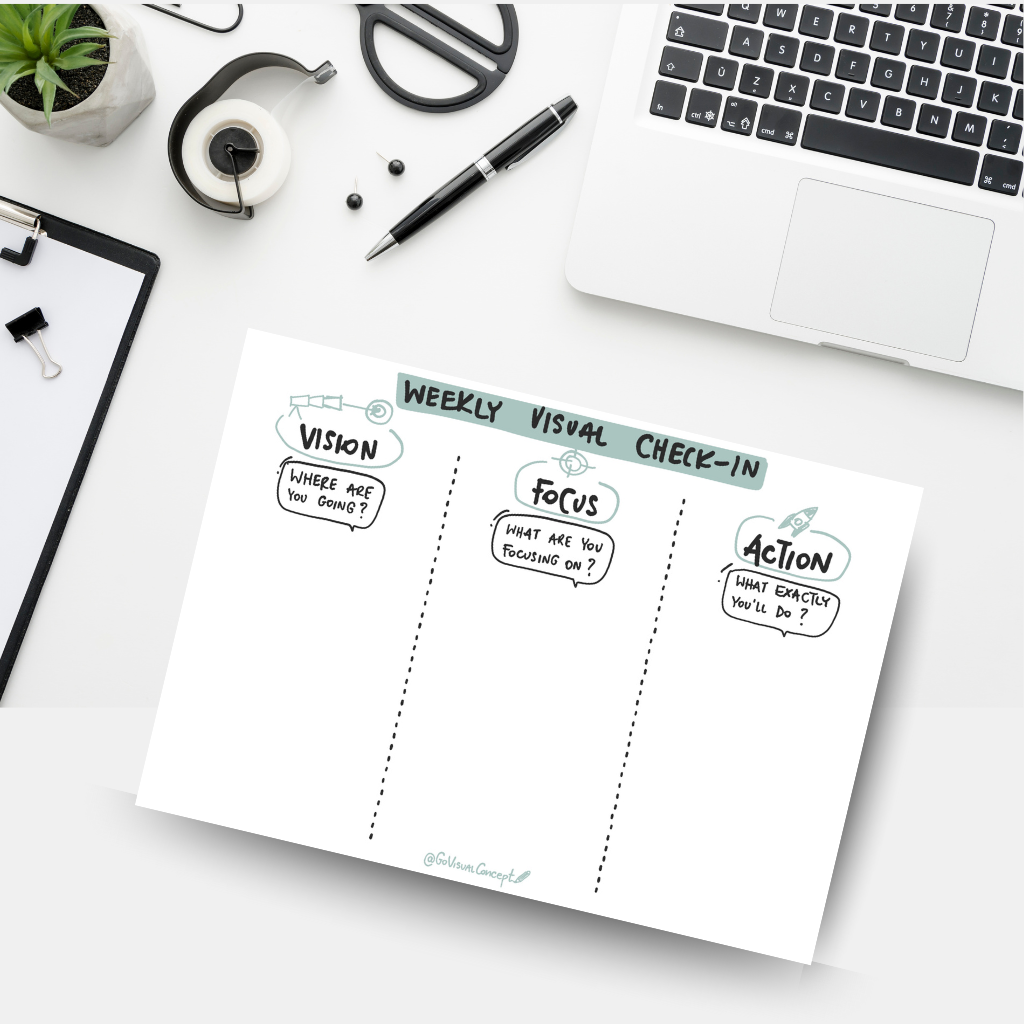
Take one sheet of paper. Draw three large, overlapping circles: Vision • Focus • Action. These aren’t fancy strategy terms. They’re your compass points.
2. Reconnect
Ask yourself: What are we really trying to achieve? Not this week. Not this quarter. In the big picture. Write it in the Vision circle. One sentence. Keep it human.
3. Review
Look at your current projects, meetings, decisions. In the Focus circle, write the 1-3 priorities that are moving you toward that vision. In the Action circle, list the key tasks for the week.
4. Adjust (The Magic Step)
Now, look at the map. Are your “Actions” truly serving your “Focus”? Is your “Focus” truly serving the “Vision”? Cross out what’s noise. Be honest. Half your calendar is probably legacy commitments that no longer serve the goal.
5. Share Visually
Send your team a snapshot. Or sketch it in your next standup. Don’t explain everything. Just show the map.
That’s it.
Five minutes. One visual. Continuous alignment.
Why This Works (Better Than a Memo)
Because the human brain understands patterns faster than paragraphs.
You can write a three-page strategy memo, and people will skim it. Or you can draw three circles on a whiteboard, and suddenly everyone’s looking at the same thing—seeing connections, spotting gaps, asking better questions.
Drawing forces clarity. You can’t fake it on paper.
If your priorities are scattered, the sketch shows it. If your vision is vague, you’ll struggle to draw it. That discomfort is the point. Visual thinking doesn’t just communicate strategy—it tests it. You see your thinking. Your priorities. Your blind spots.
It’s the difference between being busy and being on course.
Case Study: From 10-Hour Meetings to 40% Faster Decisions
A Head of Engineering I worked with felt buried in 10-hour weeks of “status update” meetings. He adopted this 5-minute visual habit.
The Visual Fix:
He brought his simple three-circle map to his next leadership meeting instead of asking for updates. He just held it up and said, “Here is our Vision, and here is our Focus. How does your work fit this map?”
The Result:
The conversation immediately shifted. Instead of reporting tasks, the team started debating priorities. They cut two “legacy projects” on the spot and reduced their total weekly meeting time by 40% within three weeks. They stopped updating and started aligning.

FAQ: Your Alignment Questions Answered
Q: How is this 5-minute habit different from a to-do list?
A: A to-do list tracks tasks. This visual map tracks direction. A to-do list asks, “What’s next?” A visual map asks, “What matters?” It connects your daily actions back to the big-picture vision, something a checklist can’t do.
Q: What if I’m not an artist and “can’t draw”?
A: This isn’t about art; it’s about clarity. If you can draw a circle and write a word, you have all the skills you need. Simple, rough, and “ugly” visuals are often the most honest and effective.
Q: How do I share this with my remote team?
A: Easily. Do your 5-minute sketch on paper and hold it up to your webcam during your daily standup. Or, take 30 seconds to recreate your three circles on a digital whiteboard (like Miro, Mural, or FigJam). The tool doesn’t matter; the ritual of making alignment visible does.
Q: Why three circles? Can I use a different template?
A: You can use any template you want! The three circles (Vision/Focus/Action) are just a powerful starting point. The real magic is in the cadence—the weekly habit of zooming out. Start with this template, and once it becomes a habit, adapt it to whatever works for you.
Next Steps: Make Your Clarity Stick
The magic isn’t in the tool. It’s in the cadence. The goal isn’t perfection—it’s rhythm. Clarity loves cadence.
You don’t need a workshop to begin. You don’t need permission. You just need five minutes and a blank page.
👉 Want the simple tool?
Download the Visual Alignment Habit Tracker 📄—a printable one-page template designed to keep you (and your team) aligned, one week at a time. It’s simple. It’s visual. It works.
👉 Want the expert-led experience?
Book a 90-minute Visual Clarity Session. We’ll go beyond the 5-minute habit and build your team’s complete one-page strategic map together, turning your vision into an actionable, aligned plan.